
Deployers Are the Application Layer for Robotics
Everyone in robotics is building picks and shovels. Someone still has to dig.
I spent the past month shaking hands across Silicon Valley’s robotics scene. Model labs, hardware makers, teleop shops, data pipelines. Everyone I met is building the same thing: infrastructure. Picks and shovels, all the way down.
Good - someone has to make the picks and shovels. But a pick is only valuable if someone is digging with it. At the end of the day, this entire stack exists for one group: the companies that drive to middle-of-nowhere Nebraska and make a robot do a real job for a real customer.
These are the deployers. And my company is one of them.
What does it mean to deploy a robot?
A deployment is not “ship the robot and turn it on.” It’s a process, and it is very different from the elegant world of software distribution that Silicon Valley is used to.
It starts with the customer. That factory in Nebraska, an elder care center filled with grandmas, a hospital, whatever you fancy. You walk the site, find the task that’s worth automating, and define what success means in numbers the customer cares about - totes per hour, patrols per night, BMWs assembled.
The next step is to figure out the best robot for the job, which involves swapping between various hardware and models based on what gets the task done. Whatever combo you decide to go with, note that you will need to configure your robots specifically for your customer, which involves a good deal of technical work as well as mapping the entire site physically. Finally, you agree on support with your customer: who calls whom when something goes wrong at 3am, which it will. Once you’re done with all this - blood, sweat, and tears - your robots are officially bare-minimum stable.
After setup, you run the autonomy loop:
- Start with no autonomy. A customer won’t wait for months to get full autonomy rolling, so you have a human manually drive the robot until then. In the process of doing this, you learn the site and collect data, which further improves progress towards autonomy (hence the ‘loop’). You get some revenue here, although your margins are slim.
- Autonomy with some help. The AI model takes over roughly 80% of the task and a human catches the rest. You use the data from this to further tune your robot to your customer’s site.
- The inch-by-inch 99%+. You keep tuning and swapping in new tech until you get to the magical 99% number.
You’re probably a little disheartened at this point - how in God’s name can this be scalable? The good news: every part of the process is getting cheaper.
Deployment platforms cut the cost of getting started.
A new wave of companies is building explicitly for deployers: dimensionalOS, who we’re partnering with, is building an operating system to let deployers quickly get started on any embodiment with the same set of software primitives. Need to swap out hardware in the middle of a deployment? Easy. These operating systems also come packed with other goodies to make life easier, including embodiment-agnostic teleoperation infra. OpenMind is another company in a similar league, and I’m sure dozens will follow.
These companies understand: the pioneering deployers will be setting the reputation for the whole ecosystem, and so it’s critical to help them win.
Models are improving fast.
In April, Physical Intelligence shipped π0.7 and it did tasks it was never trained on, which surprised their own researchers. NVIDIA’s GR00T N1.7 came with the first scaling law for dexterity: 1,000 to 20,000 hours of human video more than doubled task completion. GR00T N2 lands by year end and NVIDIA says it succeeds on new tasks in new environments twice as often as today’s best VLAs. Generalist’s GEN-1.5, out this month, hit 83% on new manipulation tasks after about five minutes of task data. Thirteen embodied foundation models shipped in June alone.
For deployers, this is beautiful news. Over time, the overall effort required to hit that 99% number will reduce.
Hardware is cheap now, mostly.
We’ve all heard Chinese hardware is cheap, but unless you’ve lived in the robotics space, the gap is hard to believe. The recent FCC action does limit China heavily, but I think workarounds will emerge anyway. Booster, AgiBot, and others are already localizing, and conditional approvals exist. These will be generational global companies, and the US doesn’t have the manufacturing base to compete on cost. Commercial deployments will run at least partly on Chinese hardware. The exceptions are defense and critical infrastructure, obviously, and that’s a clear opening for US manufacturers.
Why all of this flows to deployers.
Putting it together: deployment platforms abstract hard parts about the real world, the model layer gets us to full autonomy faster, and hardware is getting really cheap. Every layer is improving independently, and every improvement lands on the same place: the loop that the deployer runs.
And the deployment loop gives something back to all these people. The real-world data we find is used to directly improve the whole ecosystem. Deployers are not downstream of everyone; we are their input.
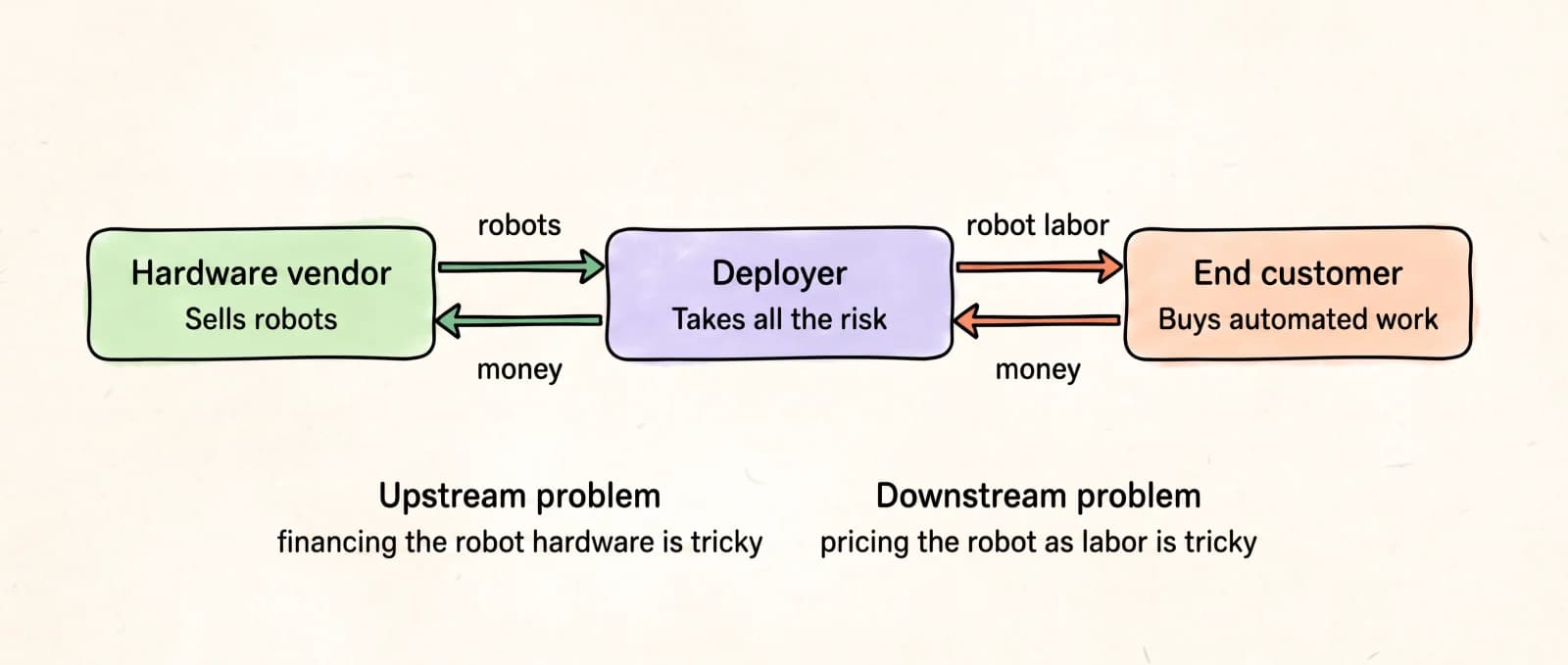
The fundamental truth is that deploying is risky real-world work. Things will break, and customers will yell at you. But this is why, if they’re good, deployers will eat the lion’s share.
Originally published on Substack at recko10.substack.com/p/deployers-are-the-application-layer
Have a job a robot should be doing?
If you run a facility with the kind of hard, dull, or dirty labor a robot should be doing, and you want to be early, talk to us.
Book a demo