
Robonomics
Nobody has figured out how to price a robot — not the bank above the deployer, and not the customer below.
Sitting across from me in my favorite Bar Sprezzatura in SF were three founders. At first glance you wouldn't suspect anything out of the ordinary, but if you squinted, you'd realize they were running some of the most bleeding-edge hardware companies in the world. Over the past month, I wedged into SF's robotics circles and met whoever there was to know.
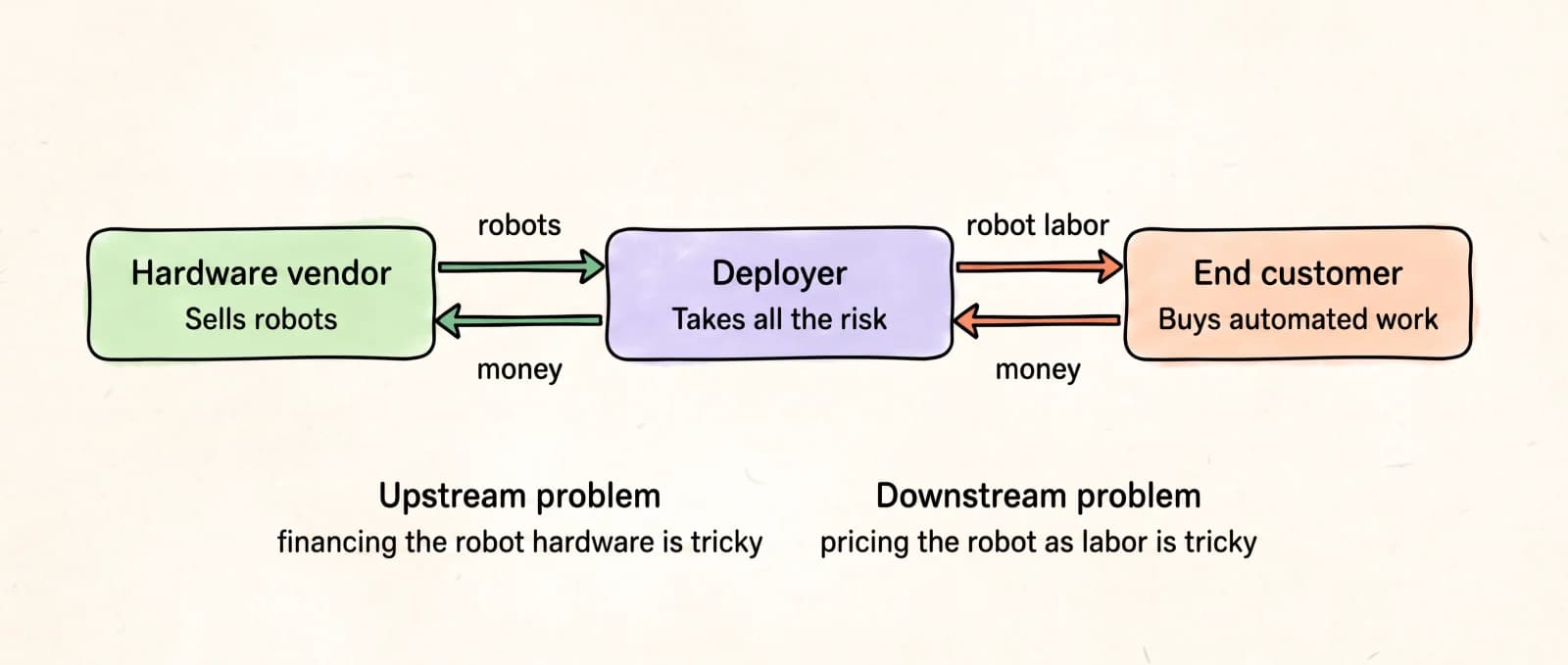
When I got back to NYC, I couldn’t stop thinking about the common concern I heard from every hardware vendor: they were struggling to sell to deployers. If you didn’t read my last article, deployers are the application layer of robotics - the companies that buy robot hardware, couple it with their own domain-specific tech, and assume the risk of getting it to work for a customer. I myself am the CEO of a deployments company.
Deployers are universally beloved because they bring in money from end-customers. But they're also a rare breed, and the reason is that nobody has figured out how to price a robot yet. Upstream, hardware vendors can't sell to deployers because no bank will finance the purchase, and most deployers can't pay cash. Downstream, deployers need a way to charge for robot labor when they don't yet know what it costs them. The deployer sits in the middle of both problems, and they happen to be the only party that can solve either of them.
Upstream problem: financing expensive robot hardware
If you’re a deployer, you have capital problems: a fleet of robots costs real money, and you’re likely a startup strapped on cash. Having to front the full cost of hardware before a single deployment generates revenue would kill your company before it even started. Also, the fabled flywheel of “get a robot to a customer, robot improves itself, make more money” will never happen. Hardware vendors, on the other hand, have the mirror problem: they’re sitting on inventory that’s worth nothing until a deployer is running it somewhere.
The obvious fix is a third party: a bank or a leasing company that buys the hardware and rents it to the deployer. That’s how jet engines, solar panels, and half the trucks on the road get financed. It doesn’t work in robotics yet because there’s no resale market for a used robot, no actuarial data, and the borrower is a startup with no credit history. Every bank that looks at this deal says no.
As a temporary hack, hardware vendors are taking things into their own hands and becoming lenders themselves. “Do things that don’t scale”, I guess. It gets you thinking: someone is going to build robotics fleet financing, and it will be a very good business. Deployers are paying for hardware with equity that costs 25% a year; asset-backed debt costs 6%. Whoever bridges that spread will make a lot of money off of every fleet. Until that lender exists, hardware companies are eating the risk.
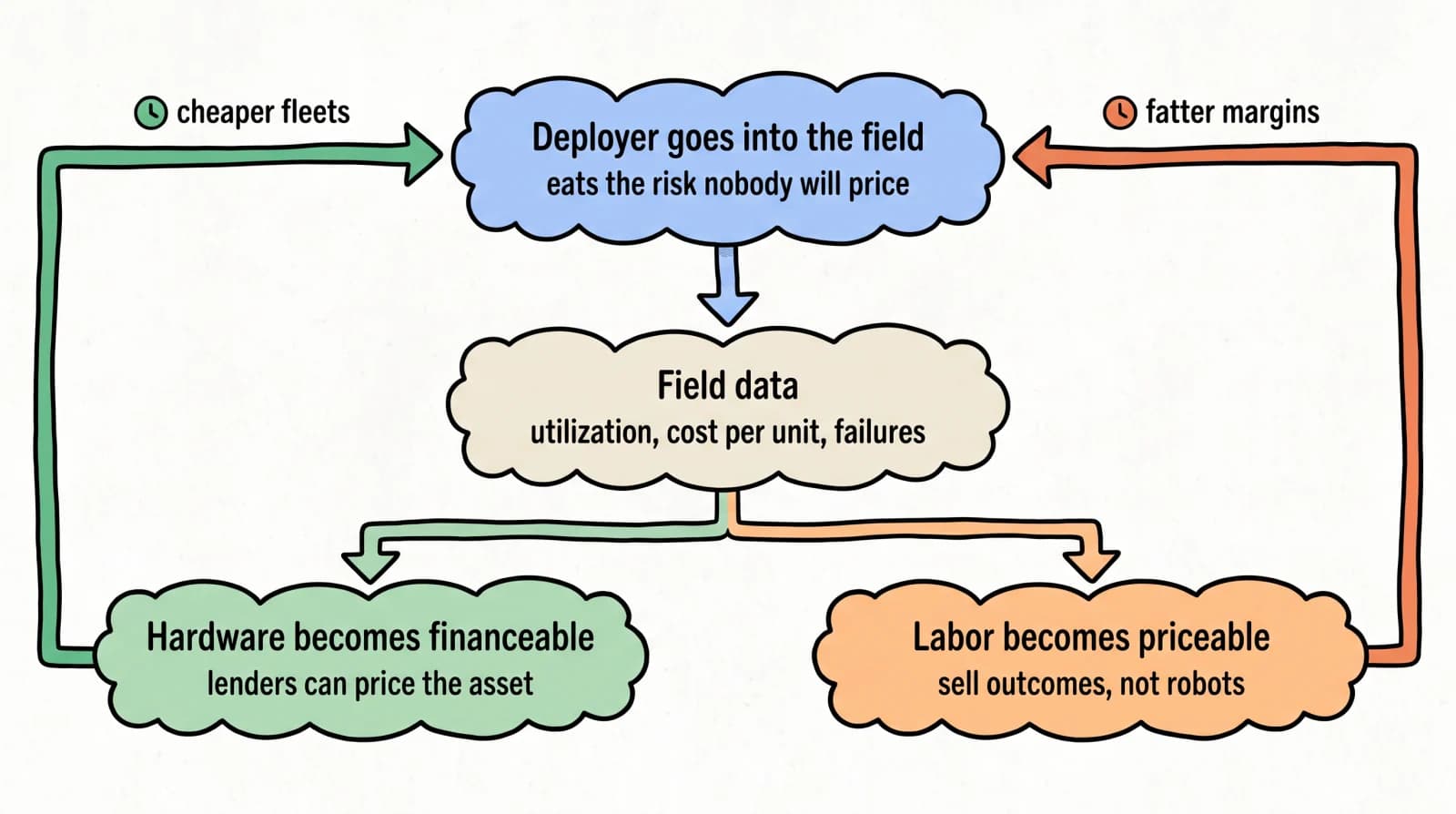
Regardless of who the lender is, we arrive at the classic chicken-and-the-egg: lenders need deployment data to price the risk of lending robots, and deployers need robots to get deployment data.
Downstream problem: charging customers
It’s now clear that financing a deployment is hard. These effects are certainly felt downstream as deployers figure out how to charge their customers. Right now, we’re in a wave of low-margin pricing models, which I think will evolve rapidly over the next few years.
Currently: Robotics-as-a-service. The customer pays a recurring fee for a working robot and never thinks more than that. It prices in the uncertainty of early autonomy, keeps the robot and its data under your control, and gives you a revenue line on day one of a deployment, when a human is still teleoperating most of the task. This model works, but it’s unclear if it can lead to a supermassive company.
Future: Outcome-based pricing. The customer pays per unit of completed work. At 95%+ autonomy this becomes one of the best businesses in the world. This would be the largest form of a deployments company.
Day one, a human drives the robot - your cost structure is labor and your contract is RaaS. As the policy takes over 80% of the task, your cost per unit of work drops and your margin expands while the customer’s bill stays flat. At 95%, you can stop charging for the robot and start charging for the outcome, because you finally know what the outcome costs you.
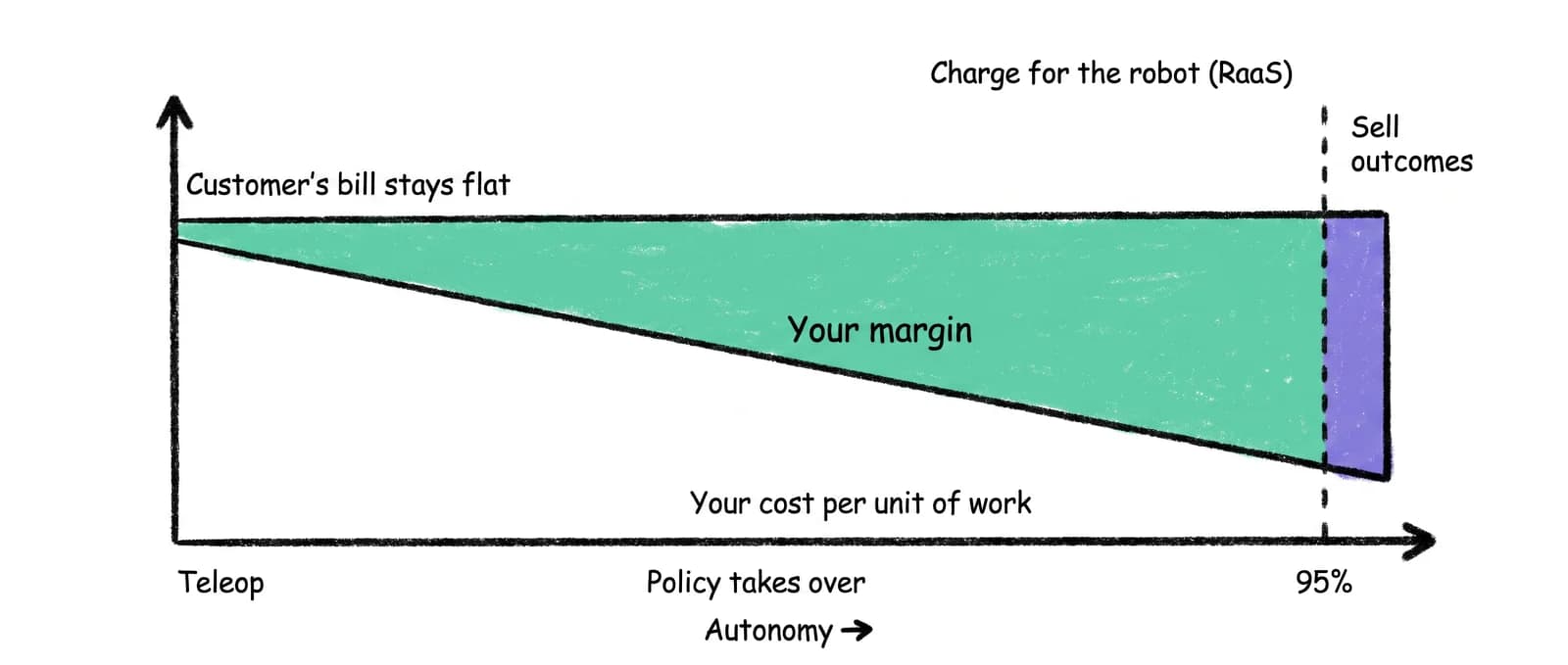
Every improvement in autonomy moves your margin up, but autonomy only improves as deployers get out there and collect real-world data. The ol’ chicken and the egg again.
Robotics is happening
Robotics has a pricing problem in both directions. Nobody can underwrite the hardware, and the pricing models are subject to evolve. Deployers fix both by being in the field and taking the initial risk. My company, Physical Turing, is one of the pioneering new-age deployers.
If you run a facility with the kind of hard, dull, or dirty labor a robot should be doing, and you want to be early, talk to me.
Originally published on Substack at recko10.substack.com/p/robonomics
Have a job a robot should be doing?
If you run a facility with the kind of hard, dull, or dirty labor a robot should be doing, and you want to be early, talk to us.
Book a demo